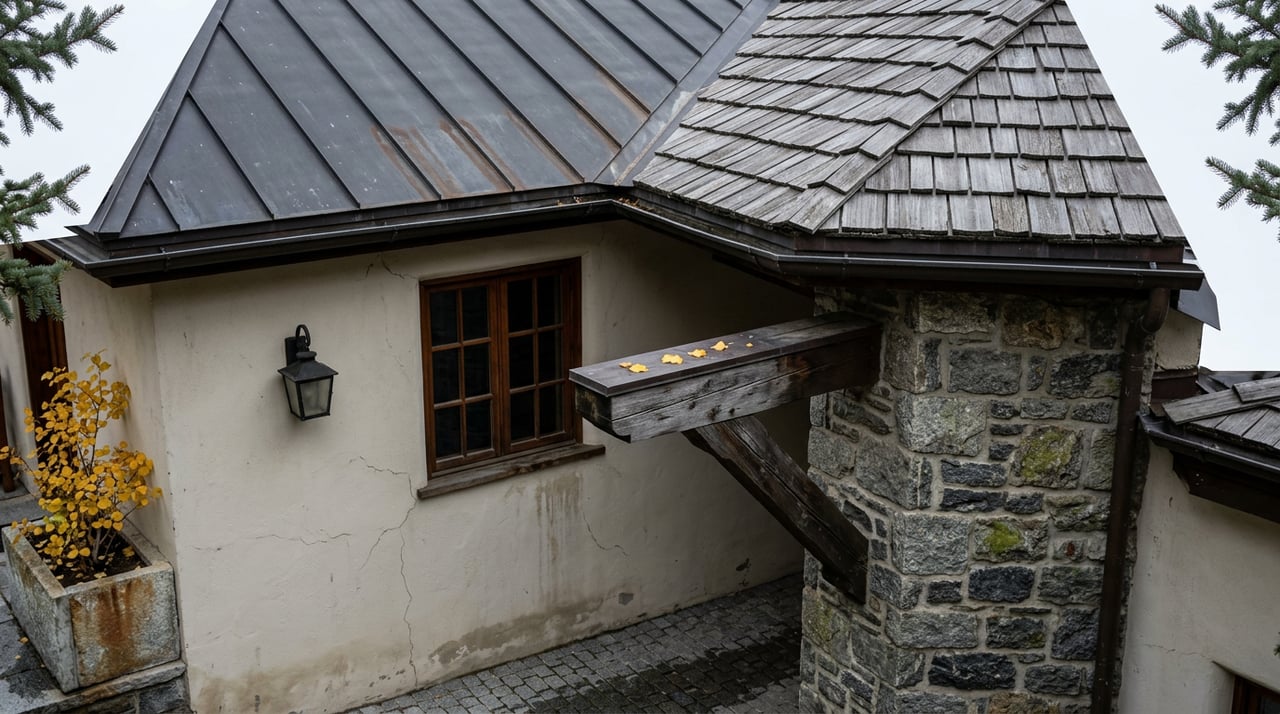
Why is half of East Lionshead Circle behind orange construction fencing at the same moment Mountain Haus is tearing out its own front entry on East Meadow Drive?
It looks like coincidence. It isn't. The Town of Vail's own weekly construction updates list seven separate building redevelopments moving through permitting and construction between this fall and next spring: 17 Vail Road, where FirstBank is rebuilding. 281 Bridge Street, where the Bridge Street Condos are adding on. 292 E. Meadow Drive, where Mountain Haus is replacing its entry. 534 E. Lionshead Circle, where a long-vacant parking deck and commercial building are becoming a luxury condominium project. And three more queued for spring: the Red Lion at 304 Bridge Street, the Evergreen at 250 S. Frontage Road, and Concert Hall Plaza at 616 W. Lionshead Circle.
Seven buildings, all moving inside a twelve-month window, in a town where major redevelopment typically trickles out one project at a time. If you're comparing condos in Vail Village or Lionshead this fall, the obvious question is which of these will disrupt a showing or a winter you've already booked. The more useful question is why they're all happening now, together, and what that timing tells you about which buildings in this market actually have a future and which ones are just old.
The buildings are the same age for a reason
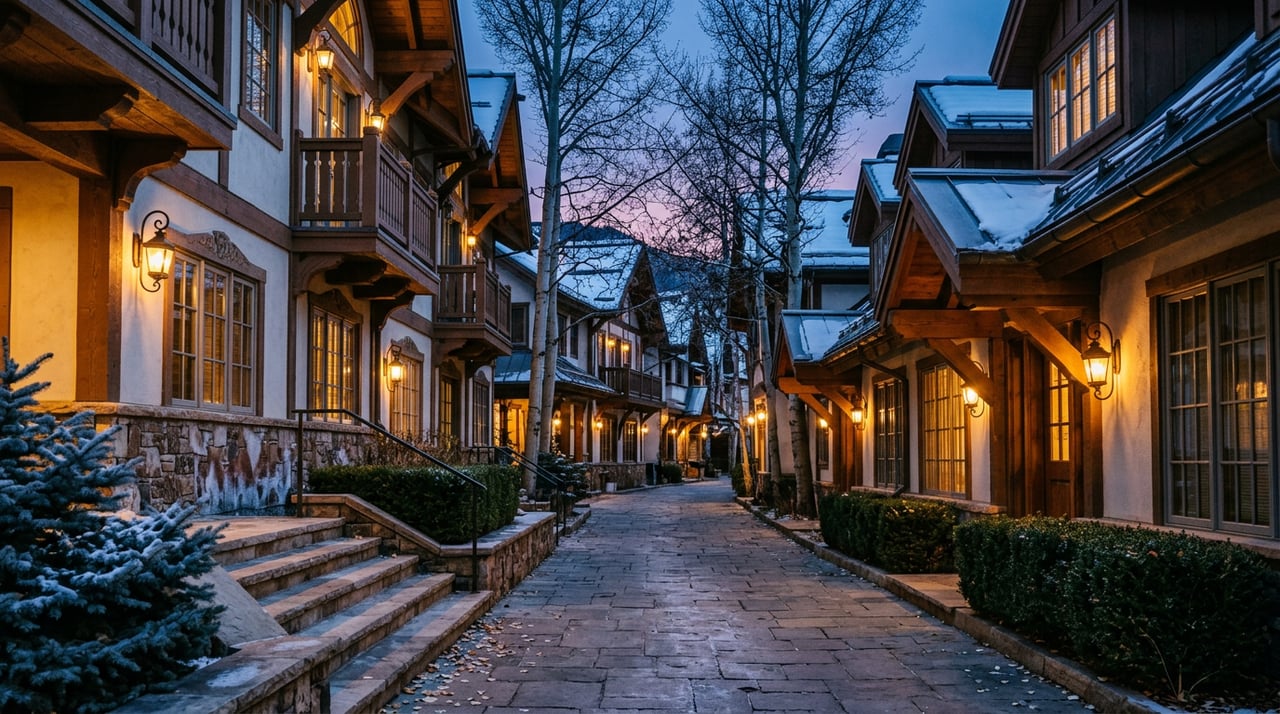
Lionshead was built fast. Development there began in 1969, and by most local accounts it wasn't built especially well. The neighborhood went through a formal reckoning with that history when the Lionshead Redevelopment Master Plan was adopted in 1996, which set off a first wave of rebuilding in the 2000s, starting with an addition to the Antlers at Vail and continuing through the Arrabelle at Vail Square in 2006 and 2007.
That first wave modernized a chunk of the neighborhood. What it didn't touch is still standing, and it's now roughly sixty years old. A parking deck and commercial building at 534 E. Lionshead Circle sat effectively vacant for years, best remembered locally as the former home of the Swedish Clog Cabin. Concert Hall Plaza on West Lionshead Circle was built in 1977 as a concert venue, converted to three stories of commercial space in the 1980s, and hasn't changed meaningfully since.
Buildings built within a few years of each other tend to hit the same wall at the same time: aging mechanical systems, outdated unit layouts, and reserve funds that finally catch up to deferred maintenance. That's the ordinary explanation for a redevelopment cluster. It's true here, but it's not the whole story, and it's not the part that should change how you shop.
The real gate isn't money or permits. It's water.
The 534 E. Lionshead Circle project, now rebranded Montelisse, is the clearest window into what's actually deciding which of these buildings gets to move forward and on what timeline. According to the Vail Daily, the project cleared Planning and Zoning Commission and Design Review Board approval last September and October, and developers didn't apply for a construction permit until this past July. What held up that gap wasn't financing or design review. It was the Eagle River Water and Sanitation District, which has to sign off on water allocation before a building this size can proceed. As of the Town of Vail's August 17 construction update, demolition of the existing Lions Pride building is scheduled to begin September 15, taking about three weeks, with excavation and construction to follow once the building permit clears.
Because Montelisse represents a significant jump in water demand for that parcel, it fell under the district's first-entitled, first-served allocation policy, meaning projects get their water in the order they clear the process, not in the order they were conceived. The district recently set Montelisse's allocation at 175 gallons per single-family-equivalent per day. That number matters because it's a marked step down from what large residential projects used to receive. Older allocation math assumed something closer to 300 gallons per SFE per day. The district revised that down after watching actual usage patterns at completed luxury projects. The Frontgate condominiums in Avon, finished in 2025, have been running under 125 gallons per SFE per day. A district board member put the underlying logic bluntly during the hearing: luxury owners cook less, go out more, and don't occupy their units year round, so they simply use less water than the old assumptions accounted for.
That's a small number with a large effect. It means the district can now approve more large residential square footage per gallon than it used to, which is part of why several projects that had been sitting in a queue are moving at once this year. But it also means every future redevelopment on a comparable parcel will get measured against the same shrinking allocation math, and the buildings that clear that hurdle first lock in a place at the front of the line. Buildings behind them wait.
What a stalled building actually costs a buyer
This is the part that changes how you should read an older, unrenovated Vail Village or Lionshead building sitting next to one that just broke ground. It isn't automatically the weaker asset.
A building with a viable, entitled path to redevelopment, even one that hasn't broken ground yet, carries real optionality. Ownership there is a bet on eventually trading into something like Montelisse's finished product: new mechanical systems, a modern layout, and pricing that reflects the neighborhood's current luxury ceiling rather than 1970s bones. A building without a clear entitlement path, or one that's further back in the water allocation queue, doesn't get that upside on the same timeline. It just keeps aging while its neighbors get younger.
That distinction rarely shows up in a listing description. It shows up in HOA meeting minutes, in whether a building has already engaged a planning firm, and in whether ownership has actually filed for the water allocation and entitlement steps that put a project on the district's list. Two buildings that look identical on paper, same era, same square footage, same view, can be sitting on very different clocks.
Living next to the work through 2027
Set the long game aside for a moment, because there's a nearer-term question if you're planning to close and move in this year. The Fall 2026 group, FirstBank, the Bridge Street Condos addition, Mountain Haus's new entry, and Montelisse, means active construction fencing and scaffolding around those specific addresses through the winter season. The Spring 2027 group, Red Lion, Evergreen, and Concert Hall Plaza, pushes disruption into next year instead. None of this is unusual for a resort town mid-cycle, but it's worth confirming before you commit to a unit with a shared wall, a shared entry, or sightlines toward any of these seven addresses.
It's also worth knowing that a larger, longer-horizon project is moving in parallel and gets confused with these seven fairly often. West Lionshead, the site long known as Ever Vail, is a 12.6-acre redevelopment led by Vail Resorts and East West Partners that could eventually bring up to 280 market-rate and deed-restricted housing units, a new base village, and a gondola portal to the mountain. That one is still in the conceptual and entitlement stage, with a pre-development agreement targeted for later this year. It's not adding construction noise to your street this winter. It is a signal, alongside the seven active projects, of how much demand this market is absorbing right now, and how much of Lionshead's older building stock still has redevelopment ahead of it.
What to actually ask before you write an offer
If you're weighing two comparable units in Vail Village or Lionshead, ask whether the building has filed anything with the Town of Vail's Community Development Department or with Eagle River Water and Sanitation District regarding future redevelopment. Ask how recently the HOA reserve study was updated and whether a special assessment has been discussed. Ask, plainly, whether the building or block you're considering falls inside the Fall 2026 or Spring 2027 construction windows, and if so, what the association has communicated to owners about access and noise.
None of this is a reason to avoid an older building. Some of the best long-term positions in this market right now are exactly the ones sitting quietly next to a construction fence, waiting their turn. The point is that in a market this tight, timing and entitlement status carry as much weight as square footage and view.
Frequently asked questions
Is the West Lionshead project the same as these seven redevelopments? No. West Lionshead, the site formerly branded Ever Vail, is a separate, much larger master-planned project still in the conceptual and entitlement stage. The seven buildings covered here are individual projects moving through permitting or construction, with active fall 2026 or spring 2027 timelines.
Will construction affect ski season access this winter? Each project has its own construction hours and fencing footprint set by the Town of Vail. If you're touring or closing on a unit near one of these seven addresses, ask the listing agent or HOA for the current construction schedule before you finalize a decision.
Does a nearby redevelopment help or hurt an older building's resale value? It can do either, depending on whether that specific building has its own viable path toward redevelopment. A building actively planning its own upgrade tends to benefit from proximity to a modernizing block. One with no plan of its own may feel increasingly dated next to newly finished neighbors.
If you're trying to figure out which side of that line a specific Vail Village or Lionshead building falls on, that's exactly the kind of on-the-ground read Led Gardner spends his time on. Contact Led for a private, no-pressure property consultation before you make a decision that depends on a building's future as much as its present.
This article is general information, not legal, tax or financial advice. Consult a qualified professional about your situation.